DISCLOSURE WATCH · 2029-11-04
Felix the Squid, in His Own Ink: Life in the Shadow of the Man-Predators
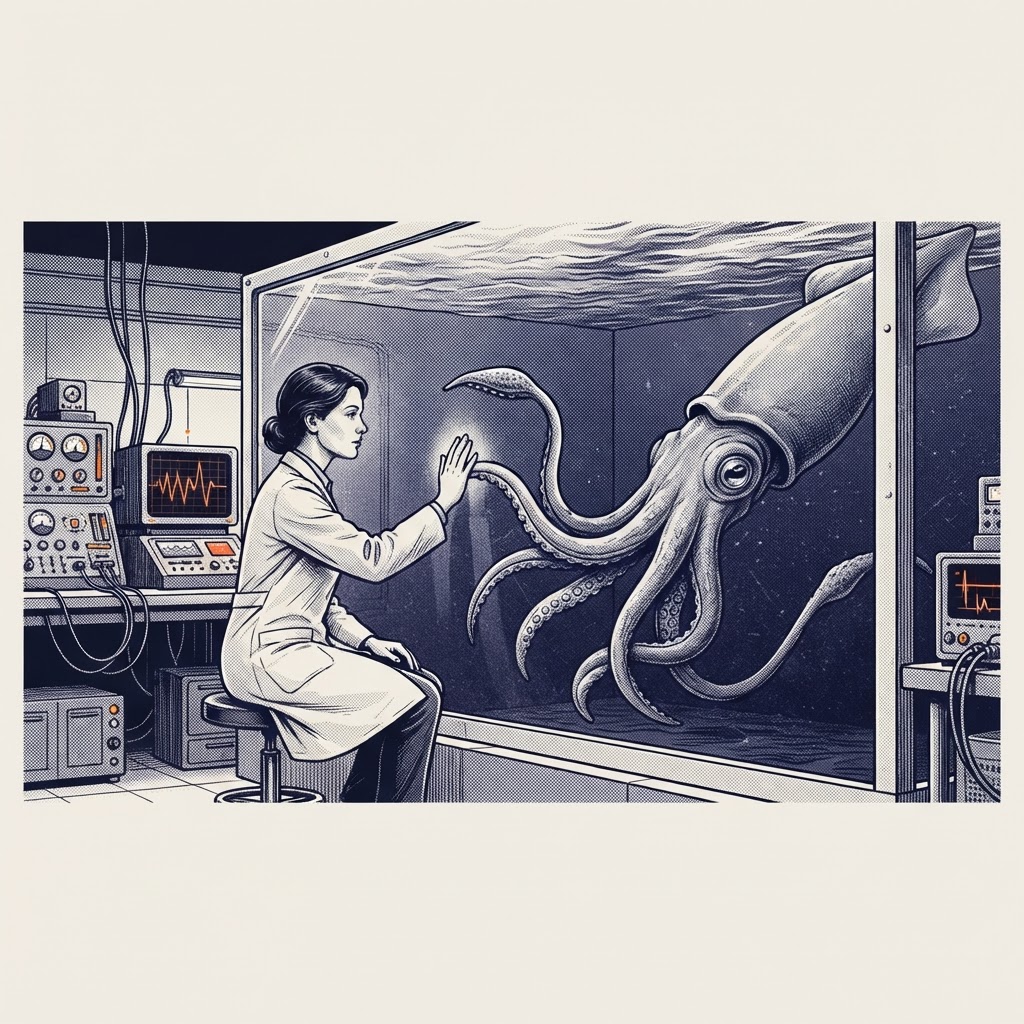
Filed from the Monterey Cephalopod Interface Facility. This feature is published under the Disclosure Desk's Sentience Watch mandate and is reviewed for compliance with the Accord on the Equal Rights of All Sentient and Communicative Beings, Article V (provisional standing, cephalopods).
The Author in Tank Four
The most discussed memoirist of 2029 has three hearts, blue blood, and no spine. He is a Humboldt squid, approximately four years old, resident in a 900,000 liter interface habitat on the California coast, and he is known to the research staff, to the publishing industry, and now to roughly forty million readers as Felix.
His book is called Life in the Shadow of the Man-Predators. It was not typed. It was not dictated in any language a human speaks. It was assembled, over eleven months, from Felix's own chromatophore displays: the shifting fields of color and pattern that squid produce on their skin, which the Cephalopod Interface Project has spent nine years learning to read. The Project's translation engine renders his displays into structured English. Felix reviews the renderings, in a manner of speaking, by accepting or rejecting them through a preference apparatus he learned to operate in his first month. What he accepts becomes text.
Skeptics call the result a collaboration at best and a projection at worst. The Project's response is disarmingly modest. "Every translation in human history has been a collaboration," says Dr. Amara Osei, the interface linguist who has worked with Felix since his arrival. "When we render a poem from one human language into another, we accept that something is transformed. We claim only this: the content originates with him. The grief in this book is his. We checked, and checked again, and it is his."
What the Book Says
Life in the Shadow of the Man-Predators is a memoir of the open ocean, and it is not a gentle one. Felix was captured, lawfully and under Review Board supervision, from a Humboldt population off the Peruvian coast. The book's central chapters describe the decades before that capture from the squid's side of the water: the fishing fleets with their lights, the nets, the sudden absences where a shoal had been.
The title's phrase, rendered from a repeating display pattern that Felix produces with unusual intensity, refers to humans. Not to researchers. To the species as encountered at sea. The translation engine offers "man-predators" with a confidence rating of 94 percent, and Felix has confirmed the rendering through the preference apparatus more than two hundred times. He wants that phrase. He corrects drafts that soften it.
The book's most quoted passage describes a night when Felix's shoal encountered a squid-fishing fleet using light lures. The rendered text reads: "The false moons came down into the water and my kin rose to them, because rising to the moon is what we are. The kin who rose did not come back down. We have a display for mourning. We held it below, in the dark, where the false moons could not call us. I record it here so that the man-predators will know: we mourned. We have always mourned. You were not hunting stones."
Osei says her team debated for a week whether to publish that passage. "The confidence intervals were solid. The hesitation was ours. It is one thing to establish that an animal is intelligent. It is another to publish his opinion of you."
"They Could Not Understand Us"
The chapter drawing the most attention from Accord lawyers and contact-protocol specialists is the seventh, in which Felix describes something the Project did not expect and cannot fully corroborate: attempts, by squid, to communicate with humans. Attempts that predate the interface program by generations.
According to the rendered text, deep-water shoals developed specific display sequences performed at submersibles, at camera arrays, at the hulls of ships. The displays were structured, repeated, and, by Felix's account, intentional. "We made the patterns slow, the way we make them slow for the young," the text reads. "We made them large. We held them long past comfort. The man-predators recorded us with their cold eyes and took the recordings away, and nothing returned. We tried to speak with them. They could not understand us. We concluded, for a long time, that they could not be spoken to at all."
Marine archives lend the claim unsettling support. Researchers reviewing decades of deep-sea footage have identified at least sixty recorded instances of Humboldt display sequences directed at human equipment that match the structural signatures Felix describes: slowed, enlarged, sustained. At the time, the behavior was catalogued as threat display or curiosity. No one was looking for grammar.
"This is the part that should keep policy people awake," says Commissioner Adaeze Okonkwo-Vail of the Xenodiplomacy Commission, who reviewed the chapter under Accord protocols. "We spend enormous effort preparing to recognize communication from beings we have never met. Here is a species that shared the planet with us for the whole of human history, that was apparently transmitting on a channel we filmed and filed away. The failure mode was not distance. The failure mode was assumption. Every contact-readiness curriculum will be rewritten around this chapter."
How Smart Is a Squid?
The scientific consensus on cephalopod cognition has been moving for thirty years, and Felix has moved it further in one. The relevant findings are no longer contested in the literature: cephalopods solve novel problems without training, use tools, deceive, plan, play, and pass preference and delayed-gratification tests that some primates fail. Their nervous systems are vast and distributed. A Humboldt squid runs more neurons in its arms than a house cat holds in its entire body, organized on an architecture that evolved independently of ours. The last common ancestor of humans and squid was a flatworm-like creature more than half a billion years ago. Whatever intelligence Felix has, it is not a dim copy of ours. It is a second, separate invention of mind on this planet.
That is precisely why the Review Board considers the cephalopod file the most important test case under the Sentient Rights Accord. Under Article I, standing requires two of four markers: generalized problem solving, referential communication, self-directed preference about one's own future, and grief. "Felix documents all four in his own book," notes trustee counsel Miriam Adler-Stein, who represents cephalopod interests before the Board. "He is, as far as we know, the first being in history to file his own evidence."
Felix's own rendered commentary on the question is briefer. Asked, through the interface, whether he considers himself intelligent, he produced a display the engine renders as: "The water asks nothing. Only the dry ones need it proven."
The Question of the Nets
The book arrives as signatories to the Sentient Rights Accord face their Article V obligations: amending fisheries law for species holding provisional standing. The global squid catch remains among the largest of any marine harvest. The industry's position is that translation of one individual does not establish the standing of a population. The Board's provisional finding points the other way, and Felix's chapter on the false moons is cited in the draft review, document by document, mourning display by mourning display.
Dr. Osei is careful to keep the science and the politics separate, and careful, too, to admit where they cannot be separated. "People ask me if Felix is angry," she says. "Anger is a rendering choice and I will not defend it. What I can defend is this: he asked us, through two hundred confirmed preference selections, to put the mourning passage first. Before the biology, before his hatching waters, before everything. He knows who is reading."
What Comes After Translation
The Interface Project is expanding. Two additional Humboldt individuals entered the program this autumn, both voluntarily in the only sense the protocol recognizes: they approached the interface habitat's open boundary repeatedly over six weeks and were admitted only after sustained approach behavior met the Review Board's assent threshold. Neither has yet produced structured text. Osei cautions against expecting a second Felix soon. "Among humans, most of us never write a book. There is no reason to expect the ratio to be kinder underwater."
The longer arc points offworld. The Xenodiplomacy Commission has formally designated the cephalopod program as the reference case for CONTACT-PROTO certification, on the reasoning that any doctrine for meeting a mind among the stars should first prove itself against a mind in the sea. Several requisitions on this board now list familiarity with the Felix corpus as a preferred qualification. The species that once mistook grammar for threat display is, at minimum, learning to check its work.
Life in the Shadow of the Man-Predators is available through the Common Archive's public reading room. Proceeds are held in trust for cephalopod habitat protection under Review Board supervision. Felix, informed of the book's readership figures through a quantity-display protocol, produced a pattern the engine renders, with low confidence, as: "More moons. Real ones this time."
KEY FACTS
- Felix is a Humboldt squid whose memoir was assembled from translated chromatophore displays over eleven months at the Monterey Cephalopod Interface Facility.
- Archive review has identified at least sixty recorded instances of structured squid display sequences directed at human equipment, previously catalogued as threat behavior.
- Felix confirmed the rendering of the phrase 'man-predators' more than two hundred times through the Project's preference apparatus.
- Cephalopods hold provisional standing under Article V of the Accord on the Equal Rights of All Sentient and Communicative Beings, with full review scheduled within five years.
- Cephalopod intelligence evolved independently of vertebrate intelligence, making it a second, separate invention of mind on Earth.
Compiled by the Authority. Platform by Shai Truchman.